
Do I have a C-wire? Thermostat wiring checker
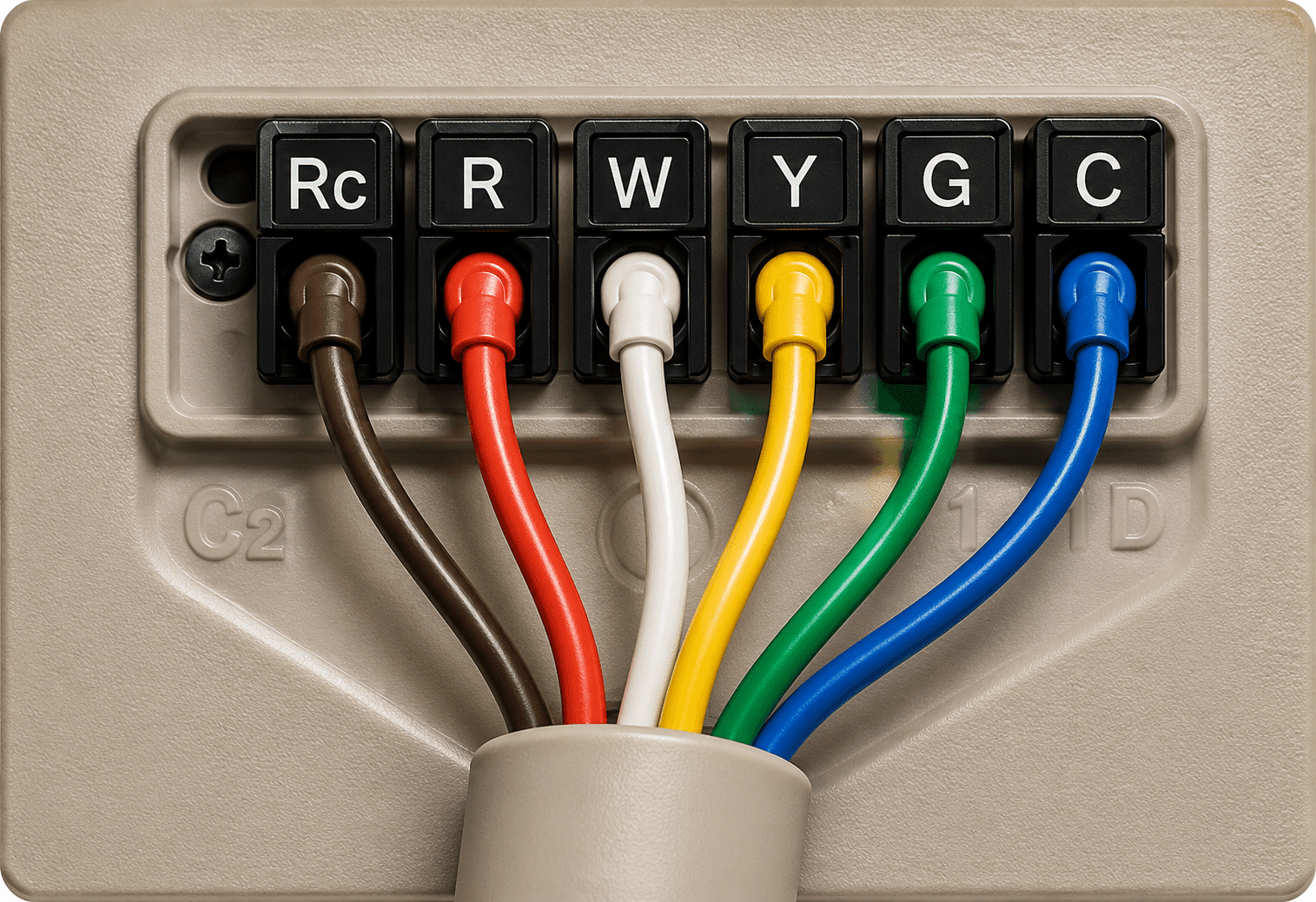
Pull your old thermostat off the wall, tick the lettered terminals that actually have a wire in them, and this tells you what system you've got, whether you have a common wire, and what your options are if you don't. It doesn't care which brand you buy.
Wiring checker
Identify your thermostat wiring and see the practical ways to power a smart thermostat. Results update immediately and stay in this browser.
Your setup
Live calculationWhat each terminal letter means
These conventions are near-universal across US residential HVAC, though occasional equipment uses its own labelling. If a letter on your block isn't here, check the equipment manual before assuming.
| Terminal | Name | What it does |
|---|---|---|
| R | Power | 24 VAC hot from the transformer. Single-transformer systems use this alone. |
| Rc | Power, cooling | Hot leg for the cooling transformer in a two-transformer system. |
| Rh | Power, heating | Hot leg for the heating transformer. Rc and Rh separate means two transformers. |
| C | Common | The return path that completes the 24 VAC circuit. This is the wire that continuously powers a smart thermostat. |
| W | Heat | Calls for heat, first stage. |
| W2 | Heat, stage 2 | Second stage of heating. Its presence means a multi-stage system. |
| Y | Cool | Calls for the compressor, first stage. |
| Y2 | Cool, stage 2 | Second stage of cooling. |
| G | Fan | Runs the blower fan independently. Often repurposed when there's no C wire. |
| O / B | Reversing valve | Switches a heat pump between heating and cooling. Its presence means you have a heat pump. |
| Aux / E | Auxiliary / emergency heat | Backup heat strips on a heat pump system. |
| L | Fault indicator | Status signal from the equipment. Not needed by most smart thermostats. |
Why the C-wire matters at all
An old mechanical or battery thermostat is just a switch. It doesn't need continuous power, because it only has to close a circuit when it wants heat. A smart thermostat has a screen, a Wi-Fi radio and a processor, all of which need power around the clock.
The 24 VAC control circuit has a hot leg (R) and a return leg (C). Without C, there is no complete circuit to draw continuous power from, so the thermostat has to get power some other way.
Power stealing, and why it causes trouble
Some thermostats "steal" a trickle of power through the heating or cooling wire without triggering the equipment. It works, but marginally — and it's behind a lot of the complaints about thermostats that reboot, drop off Wi-Fi, or cause the furnace to short-cycle or click on briefly for no reason. If you have the choice, a real common wire is always the better answer.
The realistic ways to get a C-wire
An unused wire in the wall. Thermostat cable is commonly run with more conductors than were needed. If there's a spare wire tucked into the wall cavity, you can land it on C at the thermostat and on the C terminal at the furnace control board. This is free and it's the best outcome.
A power extender kit. A small module fits at the furnace control board and multiplexes the existing wires so a common connection becomes available at the thermostat. Some thermostats include one in the box. This is the usual answer when you have four wires and no spare.
A plug-in 24 VAC adapter. Cheapest and quickest, but it means a visible transformer and a wire running to a nearby outlet. Fine in a utility space, ugly in a hallway.
New cable. The permanent fix. Usually straightforward if the run is accessible, awkward and worth paying for if it isn't.
The two situations that genuinely stop you
Line voltage. If you have two thick wires and no lettered terminals, you have a 120 V or 240 V system — typically electric baseboard or in-ceiling radiant. Standard smart thermostats are 24 VAC and will be destroyed by this. You need a thermostat specifically sold as line-voltage.
Millivolt systems. Wall and floor furnaces with a standing pilot generate their own tiny voltage from a thermopile. There's no transformer to tap, and most smart thermostats can't run on this at all.
Common questions
How do I know if I have a C-wire?
Take the thermostat faceplate off and look at the terminal block. If there is a wire landed on the terminal marked C, you have one. Don't judge by wire colour — although a blue wire is commonly used for common, plenty of installers use whatever was in the bundle, and a blue wire on the Y terminal is doing something else entirely.
Can I use the G wire as a C-wire?
Yes, with a trade-off. Repurposing the fan wire gives you a common connection but you lose independent fan control — you can no longer run the blower without calling for heating or cooling. Some people never use that function and don't miss it. If you use a whole-house fan setting or run the blower for air circulation, you will notice.
Will a smart thermostat work without a C-wire?
Often, but not always cleanly. Several models are designed to run without one, either by power stealing or by including a power extender kit. Both approaches work reliably in most installations and cause intermittent problems in a minority. If your wiring makes a proper common wire achievable, do that instead.
I have separate Rc and Rh terminals with no jumper. What does that mean?
You have two transformers — usually a separate heating system and cooling system that were installed at different times, or a boiler paired with a later air conditioning system. This matters because power extender kits generally assume a single transformer. Check the specific product's documentation before buying, and get a professional opinion if you're unsure.
Does a heat pump need different wiring?
It needs an extra connection. A heat pump reverses its refrigerant flow to switch between heating and cooling, and the O or B terminal carries that signal. If your terminal block has O, B, or O/B, you have a heat pump and you need a thermostat that explicitly supports heat pumps — not every model does.